Technical Guides
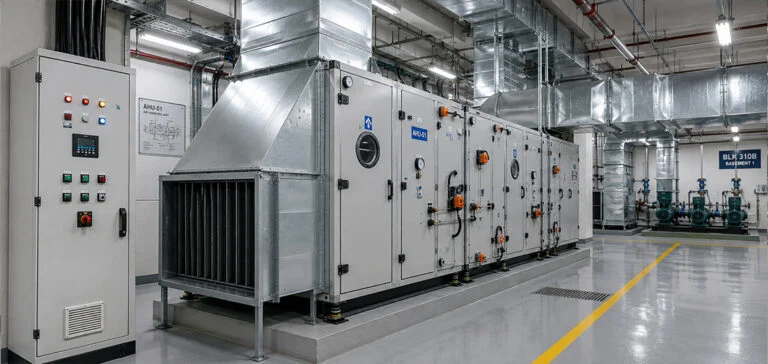
Choosing a VFD for Air Handling Units in HVAC Systems
How to choose the best VFD for an air handling unit: a checklist for fan duty, current, BACnet or Modbus, PID, EMC, IP rating, fire mode…
Read moreA variable speed drive (VSD) improves motor efficiency by adjusting the frequency and voltage supplied to an AC motor so it runs only as fast as the load requires, instead of running flat out and wasting the surplus through valves, dampers or on/off cycling. On fans and centrifugal pumps, which make up much of the […]
A variable speed drive (VSD) improves motor efficiency by adjusting the frequency and voltage supplied to an AC motor so it runs only as fast as the load requires, instead of running flat out and wasting the surplus through valves, dampers or on/off cycling. On fans and centrifugal pumps, which make up much of the motor load in Singapore buildings, a 20% reduction in speed can cut input power by roughly half, while ramped starts reduce electrical and mechanical stress.
In this article
This guide covers how VSDs save energy, where they do not, how drive and motor efficiency standards apply in Singapore, and how to plan a VSD project, with examples from the residential, commercial, institutional and industrial projects we have supplied, tested and commissioned.
Motors run most of the equipment in a building or plant. The IEA 4E Electric Motor Systems Platform reports that electric motor systems accounted for 53% of global electricity use in 2023, including 72% in industry and 36% in buildings. Singapore’s own figures are higher for large users: when NEA consulted on Minimum Energy Performance Standards for motors, it noted that motors accounted for about 80% of the 2015 electricity consumption of companies regulated under the Energy Conservation Act.
The motor itself is only one link in the chain. NEA’s Motor Driven Systems reference manual shows a typical pumping system reaching only about 49% overall efficiency and a typical fan system about 40%, once drive, motor, transmission and the driven machine are multiplied together. Most of the opportunity lies in how the system is controlled.
A VSD, also called a variable frequency drive (VFD) or inverter, converts the incoming AC supply to DC, smooths it on a DC bus, then rebuilds an AC output at the frequency and voltage the motor needs. Because an induction motor’s speed follows supply frequency, the drive can run the motor anywhere across its speed range.
Modern drives do much more than vary speed. As the NEA manual describes, they accept start/stop and sensor inputs, run built-in PID loops to hold a set point such as pressure or temperature, and report speed, current, power, cumulative kWh and running hours to a BMS or SCADA system.
By changing the frequency of the supply to the motor. An AC induction motor’s synchronous speed is set by the supply frequency and the number of poles. NEA’s manual gives the formula as synchronous speed (rpm) = (120 × frequency in Hz) ÷ number of poles. On Singapore’s 50 Hz supply, a 4-pole motor’s synchronous speed is 1,500 rpm. A drive that lowers the output frequency lowers that figure in proportion.
The drive changes the voltage at the same time. According to the Hydraulic Institute and Europump guide, in its simplest form the converter develops a voltage directly proportional to the frequency, which keeps the magnetic flux in the motor constant. Most drives build that output by pulse width modulation (PWM), switching the DC bus on and off in pulses of varying width. NEA’s manual notes that PWM has better power conversion efficiency.
| Drive output frequency | Synchronous speed, 4-pole motor | Synchronous speed, 2-pole motor |
|---|---|---|
| 50 Hz | 1,500 rpm | 3,000 rpm |
| 40 Hz | 1,200 rpm | 2,400 rpm |
| 30 Hz | 900 rpm | 1,800 rpm |
| 25 Hz | 750 rpm | 1,500 rpm |
It lets the motor start gently, run at the speed the load needs and stop under control. It also changes how the motor is cooled and stressed, so a few checks matter when a drive is added to an existing motor:
In practice, existing motors can usually stay in service. At Singapore EXPO, the replacement drives we commissioned run cooling plant motors that had been in service for more than ten years.
Fans and centrifugal pumps follow the affinity laws: flow varies with speed and power with the cube of speed. The US Department of Energy’s Adjustable Speed Drive tip sheet notes that reducing speed by 20% can reduce input power by approximately 50%. Its worked example shows a fan at half speed drawing only 2.8 kW instead of 16.4 kW, an 82.9% reduction even after allowing for lower motor and drive efficiency at that load.
A fixed-speed pump controlled by a valve still draws close to full power. The Hydraulic Institute and Europump guide Variable Speed Pumping states that flow control by speed regulation is always more efficient than control by valve, and reports savings of 30% to 50% in many rotodynamic pump installations.
The same guide estimates that 75% of pump systems are oversized, many by more than 20%. A drive lets an oversized pump or fan run at the speed the system actually needs, without changing the impeller or motor.
Starting a motor direct-on-line typically draws 6 to 8 times its rated current, according to Schneider Electric’s guide to DOL starters. A drive ramps the motor up from zero speed, keeping current close to rated values and reducing shock on belts, couplings, valves and pipework.
Lower speeds mean lower forces. The Variable Speed Pumping guide notes that hydraulic forces on a pump impeller fall roughly with the square of speed, so slower running extends bearing and seal life and reduces vibration and noise, provided the pump stays within its allowable operating range.
| Application | Load type | Typical VSD benefit |
|---|---|---|
| AHU and ventilation fans | Variable torque | High; airflow often modulated through the day |
| Chilled-water and condenser-water pumps | Variable torque, mostly friction head | High in closed loops |
| Cooling tower fans | Variable torque | High; fan speed can follow condenser water temperature |
| Basement carpark ventilation fans | Variable torque | Speed control in normal operation; fire-mode operation under SCDF rules |
| Booster and transfer pumps with high lift | Variable torque with high static head | Moderate; static head limits speed reduction |
| Conveyors, mixers, extruders | Constant torque | Process control and soft starting; energy saving roughly proportional to speed |
| Equipment running at full load most of the time | Any | Little or none |
The DOE tip sheet is explicit that drives do not save energy where equipment operates close to fully loaded most of the time. For constant-torque loads such as conveyors and positive displacement pumps, power varies roughly in proportion to speed rather than its cube, so the case rests more on process control and reduced wear. The DOE tip sheet confirms that for constant-torque loads, input power varies linearly with speed.
Since 1 October 2018, Singapore’s MEPS has required single-speed three-phase induction motors with 2, 4 or 6 poles, rated 0.75 kW to 375 kW and up to 1,000 V, to meet IE3 (Premium) efficiency, as set out in the REACH consultation linked above. A drive does not change a motor’s IE class, but it changes how many hours the motor spends at full power.
Drives have their own efficiency framework. IEC 61800-9-2 sets energy efficiency indicators for complete drive modules, power drive systems and motor starters, defining IE classes for drives and IES classes for the combined motor-drive system. Asking for these classes in a specification gives a common basis for comparing products.
Our project references show how VSD applications differ by sector.
| Sector | Project | Scope |
|---|---|---|
| Public residential | HDB estates, four Town Councils | 100+ Himel HAVSP drives for fire pump systems |
| Private residential | The Florence Residences | About 80 HAVSP drives for basement carpark ventilation |
| Commercial retail | Seletar Mall | 33 HAVSP drives, 0.75–15 kW, for cooling towers, CHW and CW pumps and carpark fans |
| Institutional | Republic Polytechnic | About 40 replacement drives for campus ventilation fans |
| Industrial | Silicon Box | HAVSP drives for four HVAC and ventilation systems, meeting project energy specifications |
| Infrastructure | Tanah Merah Ferry Terminal | Compact replacement drives for chilled-water and condenser-water pumps |
Three lessons recur across these projects:
Basement carpark fans are a common VSD application in Singapore residential and mixed developments, and they carry fire safety duties as well. Clause 7.4 of SCDF’s Fire Code 2023 requires carpark jet fan systems to be activated by the sprinkler system serving that level, provides a firefighter override at the fire command centre, requires a secondary power supply from an emergency generator, and requires the equipment to operate effectively at 250 °C for two hours.
Drive configuration has to support those duties. At Tengah Plantation C1, the HAVSP’s fire override mode supports higher-speed fan operation for smoke purging, and at Boathouse Residences the upgraded carpark ventilation system supported the condominium’s SCDF fire test after we replaced, configured and commissioned the drives.
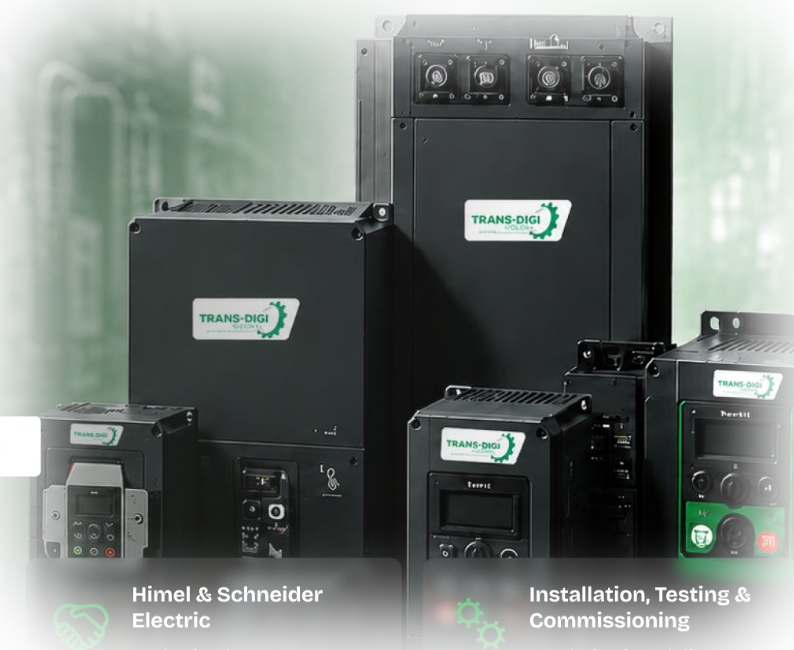
Trans-Digi Global is an authorised partner for Himel and Schneider Electric and also supplies WEG, INVT and Carlo Gavazzi products. For drives, that includes the Himel Smart Pump Series, the Himel X Series, the Schneider Altivar 212 for HVAC, the Schneider Altivar Process ATV630 and the WEG ADV200. Where a specification names a brand, we supply it; where it does not, we recommend based on the duty, lead time and budget and explain the reasoning.
Our services run from selection and supply through installation, testing, commissioning and after-sales support. For deeper reading, see reducing energy waste in pump systems and energy optimisation with the Schneider ATV212.
Related reading: how to replace a failed VFD on site, with a commissioning checklist.
It depends on the load. On fans and centrifugal pumps, a 20% speed reduction can cut input power by about half, and pump retrofits commonly report 30–50% savings. Equipment that already runs near full load saves little.
They work on standard three-phase induction motors, but savings are largest on variable-torque loads such as fans and pumps. Check the motor’s condition, insulation and cable length before retrofitting an older motor.
Yes. Since 1 October 2018, MEPS has required IE3 efficiency for common single-speed three-phase induction motors rated 0.75 kW to 375 kW.
A soft starter only controls starting and stopping, then runs the motor at full speed. A VSD controls speed continuously, which is where the energy saving comes from.
Yes, when configured for the duty and the Fire Code. We have supplied drives for HDB fire pump systems and carpark smoke-purge ventilation, with fire override settings and testing and commissioning.
Send the motor rating, a board schedule or a photo of the motor nameplate through our contact page.
Send Jason the model or your motor rating — we'll confirm availability the same business day.
WhatsApp UsHow to choose the best VFD for an air handling unit: a checklist for fan duty, current, BACnet or Modbus, PID, EMC, IP rating, fire mode…
Read more
What is a soft starter? A plain guide to inrush, thyristors, bypass and soft stop, then the Himel HASXS and HASES compared for Singapore projects.
Read more
Motor starter panel components traced along a DOL power path: breaker, RCCB, AC-3 contactor, overload relay trip class and the start and stop circuit.
Read moreSend us your motor rating, voltage, application and quantity. We'll get back to you fast.