Technical Guides

What Is a Soft Starter? How It Works, With the Himel HASXS and HASES
What is a soft starter? A plain guide to inrush, thyristors, bypass and soft stop, then the Himel HASXS and HASES compared for Singapore projects.
Read moreHow to choose the best VFD for an air handling unit: a checklist for fan duty, current, BACnet or Modbus, PID, EMC, IP rating, fire mode and bypass.
The best VFD for air handling unit fans is a normal-duty drive whose continuous output current covers the motor’s full-load current. It must speak your building management system’s protocol and hold duct pressure with built-in PID control. It must also meet the site’s EMC category and suit the plant room. Fire mode and bypass are added only where the design calls for them.
This checklist covers air handling unit, or AHU, fans only. For cooling towers and chilled-water plant, see our guide to VFDs for HVAC and cooling towers.
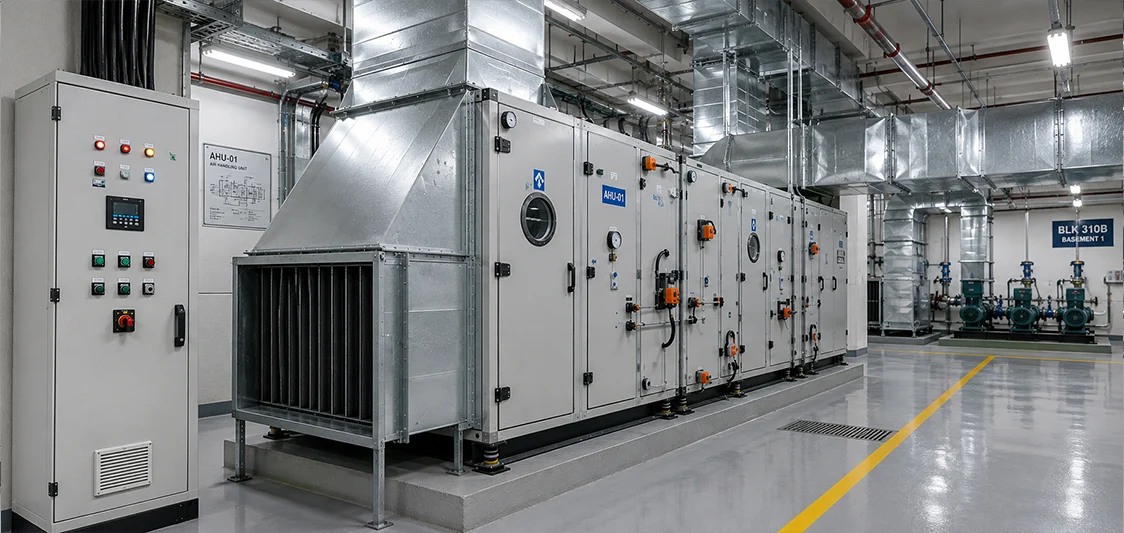
A variable frequency drive, or VFD, changes the speed of the fan motor to match the airflow the building needs. AHU fans are a typical variable speed drive HVAC application. The Carbon Trust’s technology guide on variable speed drives explains why. A fan is a variable torque load: its torque varies with the square of speed and its power with the cube of speed. The guide says slowing a fan or pump from 100% to 80% speed can save as much as 50% of its energy use.
Supply and return fans. A VFD for an AHU fan usually drives the supply fan. Larger systems add a return fan, often on its own drive. An ASHRAE Journal article on variable air volume systems describes volumetric fan tracking. A controller adjusts the return fan through its VFD to hold a fixed airflow difference between supply and return. The same article cautions that fan tracking depends on accurate airflow measurement.
Duct static pressure control. The Carbon Trust guide shows a pressure sensor in the airstream linked directly to the drive. The drive slows the motor when less air is needed, instead of a damper throttling the flow. On an AHU, the sensor usually measures pressure in the supply duct. A PID loop in the drive or the BMS then holds the pressure set point.
BMS integration. The building management system, or BMS, starts and stops the fan, sets the speed or set point and reads back faults. It does this over hardwired signals or a network protocol such as BACnet or Modbus. Our HVAC and air-handling solutions cover both protocol options, plus configurable interlocks and status, speed and fault monitoring.
How do you choose a VFD for an air handling unit? Work through the eight criteria below in order. Table 1 summarises each one and the datasheet line that answers it.
| Criterion | Why it matters for an AHU | What to check on the datasheet |
|---|---|---|
| Motor power and current | The drive must deliver the motor’s full-load current continuously | Continuous output current at the normal-duty rating, compared with the motor nameplate |
| Variable torque fan duty | Fans need less overload than machinery, so a normal-duty rating fits | Normal-duty kW, overload such as 120% for 1 minute, variable torque or square V/F control |
| BMS protocol | The drive must join the building’s control network | Embedded protocols, optional communication cards and any firmware requirement |
| PID control | Holds duct static pressure or another set point | Inbuilt PID, sleep function and feedback loss detection |
| Harmonics and EMC | Drives add harmonic current and radio interference to the supply | EMC filter category to IEC 61800-3, maximum THDi and any DC reactor |
| IP rating and plant room | Drive electronics need clean, dry and cool air | IP degree, humidity without condensation, ambient temperature and derating |
| Fire mode or override | Some fans must keep running during a fire | A named fire override or forced run function in the manufacturer’s documents |
| Bypass | Lets the fan run if the drive is out of service | The manufacturer’s bypass wiring and interlock guidance |
Start with the motor nameplate, not the kW figure alone. Our solutions page lists what we need to size a drive: motor power, full-load current, supply voltage, phase and application. Drives with the same kW label can deliver different currents. Himel’s HAVSP4T0075P datasheet gives 7.5 kW for normal duty and 17 A continuous output current. Schneider Electric’s ATV630U75N4 datasheet gives 7.5 kW for normal duty and 16.5 A continuous output current at 4 kHz. Check that the drive’s continuous current is at least the motor’s full-load current.
Tip: Send us a clear photo of the motor nameplate. It usually gives most of the electrical data needed for a first selection.
An AHU fan does not need the high overload of a conveyor or crusher. Schneider Electric rates the ATV630U75N4 at 7.5 kW for normal duty and 5.5 kW for heavy duty. Its datasheet lists a variable torque control mode. Himel’s X Series catalogue splits the range in two. The XH range is for general purpose applications. The XP range is for fan and pump applications and is rated for normal duty only, at 120% for 1 minute. Its control options include square V/F curves.
Confirm the protocol with the BMS contractor before ordering. Our solutions page notes that a protocol may be built into the drive or need an optional communication module. Schneider Electric’s ATV630U75N4 datasheet lists embedded Modbus serial and Modbus TCP, with a BACnet MS/TP module as an option. Schneider Electric states that this BACnet module, VW3A3725, needs ATV630 firmware V1.8 or later. Himel’s X Series has RS-485 Modbus RTU built in. Its catalogue mentions BACnet MS/TP, but its communication card list does not, so confirm BACnet with us first. The HAVSP datasheet lists Modbus, plus two analogue inputs and programmable relay outputs for hardwired control.
The duct static pressure loop needs a PID controller, either in the BMS or in the drive. The Carbon Trust guide notes that a process controller or the VSD itself can generate the speed demand from a pressure transducer. Himel’s X Series catalogue lists inbuilt PID with freely configurable feedback sources, two-stage PID parameter switching and feedback loss detection. The HAVSP datasheet lists an adjustable PID regulator with sleep mode. Feedback loss detection matters on an AHU. A failed sensor reading zero pressure could otherwise push the fan towards full speed.
The Carbon Trust guide notes that a drive’s rectifier design influences the harmonic content in the incoming supply.
EMC filter category. IEC 61800-3 is the EMC standard for drives, with categories such as C2 and C3. Schneider Electric states that most Altivar Process drives have integrated filters to category C2 or C3. The ATV630U75N4 datasheet gives category C2 with up to 50 m of motor cable, and C3 with up to 150 m. Himel lists the EMC filter for the X Series as an accessory. The HAVSP4T0075P datasheet states it has no EMC filter. Ask the consultant which category the building requires.
Harmonic current. Total harmonic current distortion, or THDi, measures how much the drive distorts the supply current. The ATV630U75N4 datasheet gives a maximum THDi below 48% at 80 to 100% load, to IEC 61000-3-12. Himel’s X Series catalogue describes a built-in DC reactor from 30 kW and says THDi can reach under 35%. For long motor cables, our solutions page notes a load reactor may be needed.
AHU drives are usually mounted in a panel. Schneider Electric rates the ATV630U75N4 at IP21. Himel rates the X Series and the HAVSP at IP20. All three allow relative humidity up to 95%. The Carbon Trust guide advises a clean, dry area at a temperature that allows adequate cooling. It adds that larger drives generate heat that must be removed. Check the ambient rating too. Schneider Electric gives minus 15 to 50 °C without derating for the ATV630U75N4. Himel gives minus 10 to 40 °C for the X Series, with derating from 40 to 50 °C.
Some AHUs and ventilation fans have a smoke control role. Specify this function only where the manufacturer documents it, and configure it to the fire engineer’s design.
A bypass lets the AHU fan run direct on line if the drive fails or is removed. Schneider Electric says an Altivar Process drive can be bypassed, but the circuit must be designed carefully. The drive output must be disconnected from the motor before the motor is connected to the mains. Otherwise the drive can short-circuit. Schneider Electric recommends an output contactor with mechanical and electrical interlocks against the bypass contactor. On bypass, the fan runs at full speed with no duct pressure control. The bypass contactor and overload relay form a starter circuit, covered in our guide to motor starter panel components.
Safety note: Installing, wiring, bypassing or commissioning a drive is electrical work. It must be done by a qualified, licensed electrical worker following the manufacturer’s manual. In Singapore, electrical installations follow SS 638, the Code of Practice for Electrical Installations.
The best variable frequency drive for HVAC systems with AHUs is the one that passes every line of the checklist for your fan. Table 2 compares three ranges we supply.
| Checklist item | Himel X Series, XP range | Himel SMART Pump Series, HAVSP | Schneider Electric ATV630 |
|---|---|---|---|
| Power range | 0.75 to 185 kW | 2.2 to 315 kW | 7.5 kW normal duty in the ATV630U75N4 example |
| Duty | Normal duty, 120% for 1 minute | Normal duty | Normal duty and heavy duty |
| BMS protocol | Modbus RTU built in, BACnet MS/TP to be confirmed | Modbus | Modbus serial and Modbus TCP; BACnet MS/TP module optional |
| PID control | Inbuilt PID with sleep function | Adjustable PID regulator with sleep mode | Embedded process monitoring and control |
| EMC filter | Accessory | None in the 7.5 kW datasheet | Integrated, C2 up to 50 m or C3 up to 150 m |
| IP rating | IP20 | IP20 | IP21 |
| Fire mode | Not listed in the catalogue | Fire override mode | Forced mode from firmware 1.8 |
Himel X Series. The XP range targets HVAC, fan and pump applications. If you need a Himel variable speed drive in Singapore for fans, start here.
Himel SMART Pump Series. The HAVSP is designed for pumps, but its datasheet also lists fan and chiller applications. At Global Indian International School, we supplied HAVSP drives for the AHUs, configured them to the required operating accuracy, then tested and commissioned them. At Republic Polytechnic, about 40 replacement HAVSP drives were configured to work with the existing campus controls for ventilation fans.
Schneider Altivar Process ATV630. Projects that specify a Schneider HVAC VSD in Singapore can use this range, with its integrated EMC filter and optional BACnet module. Our product page lists fans and pumps among its typical applications.
Send us:
Our supply, testing and commissioning services cover selection, parameter configuration and handover. Our VSD commissioning and start-up procedure explains what happens on site. For the energy background, read how variable speed drives improve motor efficiency.
Looking for a variable speed drive in Singapore for an AHU retrofit or a new building? Send us the details above and we will propose drives, with datasheets, matched to the checklist.
The best VFD for an air handling unit is a normal-duty drive whose continuous current covers the motor’s full-load current. It should support your BMS protocol and include PID control for duct pressure. It should also meet the EMC category for the building and suit the panel conditions.
Normal duty suits most AHU fans, because a fan is a variable torque load. Himel’s X Series XP range for fans and pumps is rated for normal duty at 120% for 1 minute. Schneider Electric rates the ATV630U75N4 at 7.5 kW for normal duty and 5.5 kW for heavy duty. Size it to the motor current either way.
Only if the building management system uses BACnet. Many systems use Modbus or hardwired signals instead. Schneider Electric makes a BACnet MS/TP module for the ATV630, needing firmware V1.8 or later. Himel’s X Series catalogue mentions BACnet MS/TP, so check the card with us. Confirm the protocol and points list with the BMS contractor before you order.
Either works. The Carbon Trust guide notes that a process controller or the drive itself can turn a pressure signal into a speed demand. Running PID in the drive keeps the loop local to the fan. Running it in the BMS keeps all set points in one place. Agree the choice with the controls designer before commissioning.
Yes, if the panel has a properly designed bypass. Schneider Electric says the drive output must be disconnected before the motor is connected to the mains. It recommends an output contactor interlocked mechanically and electrically with the bypass contactor. A licensed electrical worker must carry out this work.
Inside a clean, ventilated panel, IP20 or IP21 drives are normal. The Himel X Series and HAVSP are IP20, and the Schneider ATV630U75N4 is IP21. All three allow relative humidity up to 95%. Keep the panel dry and away from cooling coils and drain pans, and check the drive’s ambient temperature rating.
Send Jason the model or your motor rating — we'll confirm availability the same business day.
WhatsApp UsWhat is a soft starter? A plain guide to inrush, thyristors, bypass and soft stop, then the Himel HASXS and HASES compared for Singapore projects.
Read more
Motor starter panel components traced along a DOL power path: breaker, RCCB, AC-3 contactor, overload relay trip class and the start and stop circuit.
Read more
A VSD startup procedure in eight phases, from pre-power checks and auto-tuning to load tests and handover, with a VFD commissioning checklist table.
Read moreSend us your motor rating, voltage, application and quantity. We'll get back to you fast.