Technical Guides
Choosing a VFD for Air Handling Units in HVAC Systems
How to choose the best VFD for an air handling unit: a checklist for fan duty, current, BACnet or Modbus, PID, EMC, IP rating, fire mode…
Read moreWhat is a soft starter? A plain guide to inrush, thyristors, bypass and soft stop, then the Himel HASXS and HASES compared for Singapore projects.
A soft starter is an electronic device that starts an AC motor gently. It raises the voltage to the motor step by step, so the motor speeds up smoothly instead of jumping to full speed. Once the motor is up to speed, an internal contactor takes over and the motor runs normally. Many soft starters also slow the motor down gently when it stops.
The first half of this guide is for anyone who is not an engineer. The second half compares two Himel ranges for engineers and buyers.

Think of a car pulling away from traffic lights. You can floor the pedal, or you can press it gradually. Both get you moving. The second is easier on the engine, the gearbox and the passengers.
A motor switched straight onto the mains is the “floor the pedal” version. A soft starter is the gradual version. It is a form of soft starter motor control that only manages the start and the stop. In between, the motor runs at its normal full speed.
The international standard for these devices is IEC 60947-4-2. It covers semiconductor motor controllers, starters and soft-starters on circuits up to 1,000 V AC, according to IEC.
The simplest way to start a motor is a direct-on-line start. A contactor connects the motor straight to the supply. It is simple, but it has side effects.
Schneider Electric states that a motor started this way can draw six to eight times its normal running current. This starting surge is called inrush current. Schneider Electric notes that this surge can cause voltage dips that affect other devices. It also notes that the abrupt start causes mechanical stress.
Carlo Gavazzi adds that higher-efficiency motors may need even more current to start, up to 15 times rated current. Its soft starter brochure lists three results: disturbance to the supply network, tripping of protection equipment, and water hammer in pump installations.
In a building, that might mean lights flicker when a large pump starts. It might also mean a breaker trips, or pipes bang.
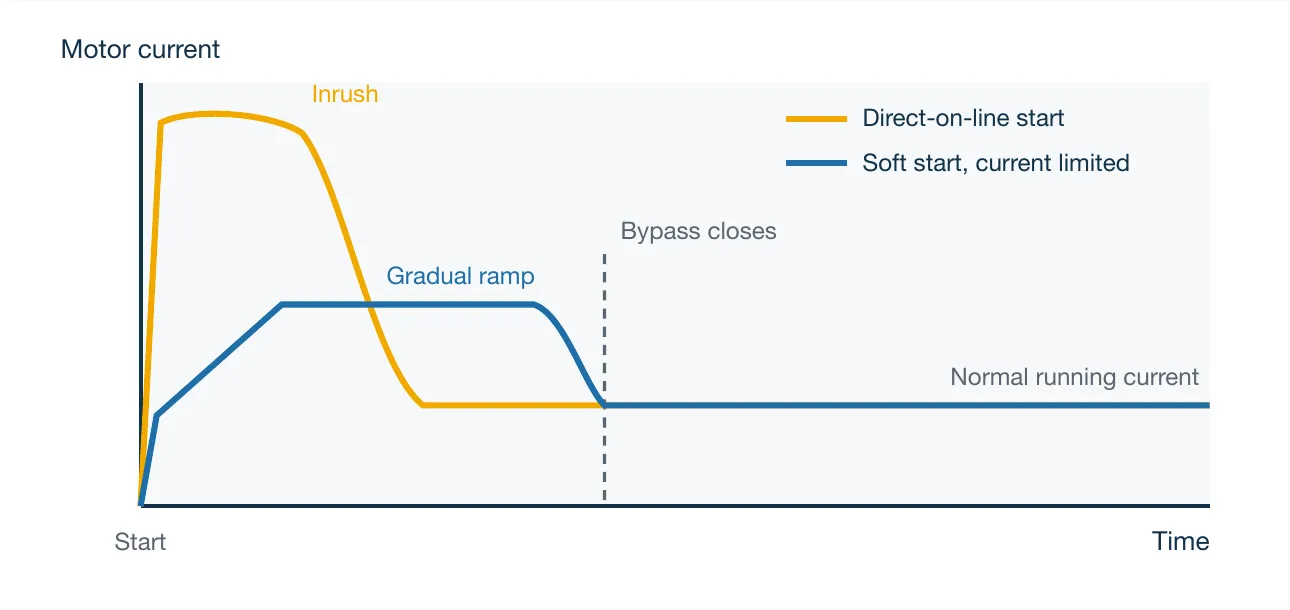
Inside the soft starter are power semiconductors called thyristors, also known as silicon controlled rectifiers or SCRs. Schneider Electric describes them as back-to-back thyristors that regulate the voltage supplied to the motor.
Each thyristor acts like a very fast switch. It lets through only part of each cycle of the mains supply. Schneider Electric explains that varying the firing angle sets the output voltage. The soft starter then increases the voltage gradually until it reaches the full value.
Lower voltage means lower current and lower torque at the start. So the motor accelerates smoothly, without the large surge. Schneider Electric notes that a soft starter limits the current supplied during the start and avoids sudden jolts in the machine.
Soft starters differ in how many phases they control. The Himel HASES catalogue, for example, lists two-phase control.
Thyristors are not perfect conductors. Schneider Electric explains that the voltage drop across them creates power losses and heat. That is why most soft starters use a bypass contactor. Once the motor reaches full speed, the contactor closes and carries the current instead.
Schneider Electric says the bypass is used in about 95% of cases, mainly to remove this heating. Himel describes the built-in bypass on the HASES as significantly reducing energy loss inside the soft starter. Carlo Gavazzi notes the same benefit for its own compact range: less heat dissipated inside the electrical panel.
On some soft starters, such as the Schneider Electric ATS48, the bypass contactor is a separate device. Both Himel ranges in this guide have the bypass built in. Himel notes that this decreases wiring.
When a pump stops suddenly, the moving water inside the pipe has nowhere to go. Check valves slam shut and the pipe can bang. This is called water hammer.
A soft starter can ramp the voltage down instead of cutting it off. The motor and the pump slow down gradually. Schneider Electric’s Altistart 22 catalogue lists controlled deceleration and stopping for centrifugal pumps to reduce water hammer. Trans-Digi Global’s Himel HASES page lists the same aim: helping to minimise pressure surges in pumping systems.
Tip: soft stop is a setting, not a default on every unit. Check that the soft stop time is set during commissioning for pump duty.
The table below summarises the whole cycle.
| Stage | What the soft starter does | What the motor and plant feel |
|---|---|---|
| Start | Thyristors raise the voltage gradually | Lower starting current, smaller voltage dip, smooth torque |
| Running | Bypass contactor closes and carries the current | Normal full speed, less heat inside the starter |
| Stop | Voltage ramps down if soft stop is set | Gradual slowdown, less water hammer on pumps |
| Throughout | Built-in protection monitors the motor | Fault trips on conditions such as overload, depending on the model |
A soft starter does not change the speed the motor runs at. Schneider Electric is clear that a soft starter changes only the voltage, and cannot control speed.
You probably need a soft starter when all of these are true:
You need a variable speed drive, or VSD, instead when the load changes and the motor should run slower for part of the time. Schneider Electric notes that a VFD changes both voltage and frequency, and works throughout the motor’s operation.
We cover that choice in detail, with a decision table by pump duty, in our soft starter vs VFD comparison. For individual product ranges, see our Schneider ATS22 guide, Schneider ATS480 guide and Carlo Gavazzi soft starter guide.
Trans-Digi Global supplies two Himel soft starter families. Both start three-phase asynchronous motors with a voltage ramp and both have a built-in bypass. They differ in size, settings and interface.
The Himel HASXS Soft Starter is the model range of the Himel Expert Soft Starter, which Himel calls its Expert Series. Our product page lists 11 to 600 kW, a built-in keypad and display, and overload, phase-loss and overcurrent protection. The Himel data sheets add Modbus communication and utilisation category AC-53B.
The Himel HASES Soft Starter is described by Himel as a miniature digital soft starter. Three potentiometers set the start time, stop time and initial voltage, and it mounts on a DIN rail. Himel shows it paired with a manual motor starter, such as the Himel HDP6 motor circuit breaker, as a compact alternative to a star-delta starter.
| Feature | Himel HASXS | Himel HASES |
|---|---|---|
| Series | Expert Series | Easy series, miniature digital |
| Motor power or current | 11 to 600 kW at 380 to 440 V; starter rating 25 A to 1,100 A | Rated currents from 4 A to 105 A |
| Supply voltage | 380 to 440 V AC, 50 or 60 Hz | 208 to 600 V AC, 50 or 60 Hz |
| Start time | Adjustable, 2 to 100 s | Adjustable, 1 to 20 s |
| Stop time | Adjustable, 1 to 50 s | Adjustable, 0 to 20 s |
| Bypass | Integrated | Built in |
| Set-up | Keypad and display | Three potentiometers, initial voltage 40 to 70% |
| Communication and signals | Modbus | Run and top of ramp relays |
| Control | Internal run, stop, emergency stop and reset inputs | Control supply of 100 to 240 V AC or 24 V AC or DC |
| Protection | Overload, phase-loss, overcurrent and motor protection | Basic electrical and motor protection |
| Enclosure rating | IP20 on the 11 kW model, IP00 on the 600 kW model | IP20 up to 15 kW, IP10 above |
| Operating temperature | Minus 10 to 40 °C, current derating above 1,000 m altitude | Minus 25 to 60 °C, derating 1% per °C above 40 °C |
| Starts per hour | Suited to frequent starting cycles | 20 |
In short, the HASES suits smaller motors where a compact, simple unit is the priority. The HASXS suits larger motors, longer ramps and plants that need a display and Modbus link.
Tip: in Singapore switch rooms, check the panel’s internal temperature against each data sheet’s operating range before you size the unit.
On real projects, we supplied a 132 kW HASXS for the fire pump system at the Singapore Rail Test Centre. At Gateway East, more than 10 HASXS units from 37 to 55 kW serve as standby starters for chilled-water and condenser-water motors. You can browse all soft starters we stock.
A soft starter is wired into the motor’s power circuit. Fitting, wiring and commissioning it is electrical work. In Singapore, electrical installations follow SS 638, the Code of Practice for Electrical Installations.
Safety note: all installation, wiring, testing and commissioning must be done by a qualified, licensed electrical worker following the manufacturer’s manual. Isolate and lock off the supply before opening any panel.
Before ordering, have these ready:
We support product selection, installation, testing and commissioning for soft starters, with handover documentation where it is in scope.
A soft starter is the simplest way to tame a large motor’s start and stop without adding speed control. Send us the motor details and the application, and we will help you choose between the HASXS and HASES, or another range we supply.
A soft starter is used to start and stop an AC motor gently. It lowers the starting current and the sudden torque of a direct-on-line start. Typical uses are pumps, fans, compressors and conveyors. It reduces voltage dips, nuisance trips and mechanical shock, and on pumps a soft stop helps reduce water hammer.
A soft starter uses thyristors to switch on only part of each mains cycle. It starts at a reduced voltage and raises it gradually to full voltage. The motor speeds up smoothly with lower current. When the motor is at full speed, a bypass contactor closes so the thyristors stop carrying current and heating up.
Not while the motor runs. A soft starter does not change motor speed, so running power stays the same. Its benefit is a gentler start and stop. The built-in bypass does reduce losses inside the starter itself. If you want energy savings from slowing a pump or fan, you need a variable speed drive instead.
Choose a soft starter when the motor runs at one fixed speed and you only need a smooth start and stop. Choose a variable speed drive when the load changes and the motor should run slower for part of the time. Our soft starter vs VFD comparison covers this decision in more depth.
The HASXS is Himel’s Expert Series for 11 to 600 kW motors at 380 to 440 V. It has a keypad, display and Modbus. The HASES is a compact unit for rated currents from 4 A to 105 A, set with three potentiometers and mounted on a DIN rail. Both have a built-in bypass.
Yes, in most cases. A soft starter works with standard three-phase asynchronous motors, so the existing motor can often stay. At Gateway East we commissioned HASXS units with motors over 10 years old. A licensed electrical worker should check the motor, wiring and protection first and follow the manufacturer’s manual.
Send Jason the model or your motor rating — we'll confirm availability the same business day.
WhatsApp UsHow to choose the best VFD for an air handling unit: a checklist for fan duty, current, BACnet or Modbus, PID, EMC, IP rating, fire mode…
Read more
Motor starter panel components traced along a DOL power path: breaker, RCCB, AC-3 contactor, overload relay trip class and the start and stop circuit.
Read more
A VSD startup procedure in eight phases, from pre-power checks and auto-tuning to load tests and handover, with a VFD commissioning checklist table.
Read moreSend us your motor rating, voltage, application and quantity. We'll get back to you fast.