Technical Guides
Choosing a VFD for Air Handling Units in HVAC Systems
How to choose the best VFD for an air handling unit: a checklist for fan duty, current, BACnet or Modbus, PID, EMC, IP rating, fire mode…
Read moreCurve types, current ratings and breaking capacity explained — how panel builders specify the right high-performance Himel HDB9H MCB the first time.
4 July 2026 · 9 min read · Trans-Digi Global
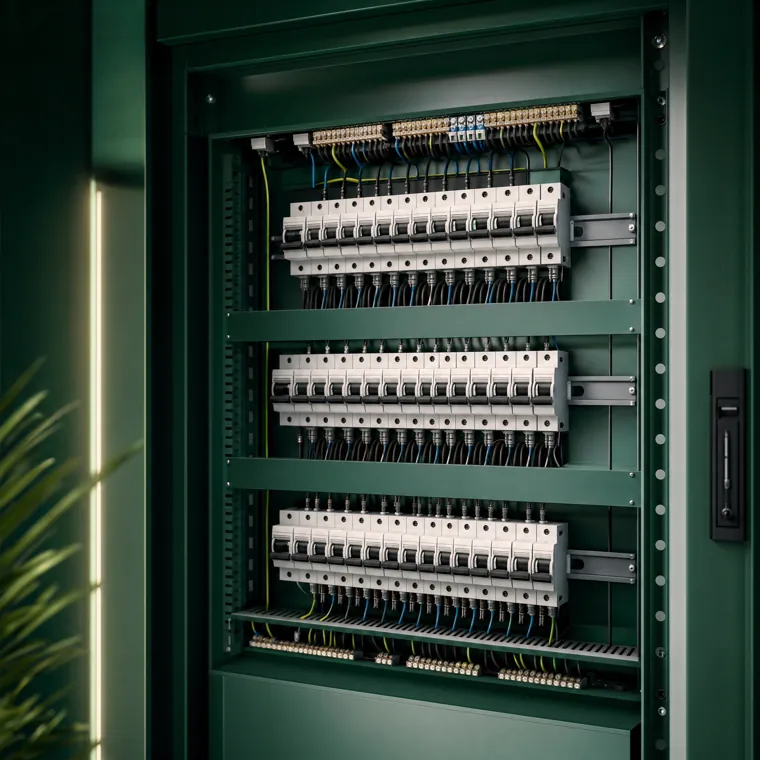
To choose the right Himel HDB9H MCB, match five things to the circuit: the rated current (In), the tripping curve (B or C for most work), the breaking capacity, the number of poles, and the standard and certification your submission calls for. The HDB9H references we stock are 18 mm-per-pole, 10 kA miniature circuit breakers tested to IEC/EN 60898-1, in ratings from 6 A to 63 A. This guide explains each choice with figures from the Himel datasheets.
In this article
A miniature circuit breaker (MCB) is a small, DIN-rail-mounted circuit breaker that protects final circuits, such as lighting, socket outlets and small equipment, against overload and short circuit. Trans-Digi Global supplies the Himel HDB9 and HDB3w MCB ranges from local Singapore stock as an authorised Himel partner.
Every HDB9H reference on our product page links to its Himel product data sheet. Taking the HDB9H63A3C32 datasheet (3-pole, C curve, 32 A) as an example:
Himel’s Panel Builder brochure places the HDB9 within a wider MCB family: the HDB9 itself covers 1 to 63 A in 1P, 2P, 3P and 4P with 6 kA or 10 kA breaking capacity and B, C or D curves, while the 27 mm HDB3w-125 extends the range to 63 to 125 A at 10 kA.
The rated current is the current the MCB carries continuously without tripping. The rule is the same as for any protective device: the design current of the circuit (Ib) must not exceed In, and In must not exceed the current-carrying capacity of the cable (Iz). In short, Ib ≤ In ≤ Iz.
The HDB9H ratings on our datasheet list are 6, 10, 16, 20, 32, 40 and 63 A (single-pole, C curve), 6 to 63 A (three-pole, C curve) and 20 A (two-pole, B curve). If your board schedule calls for a rating outside that list, ask us; the wider HDB9 family runs from 1 A upwards.
The curve describes how quickly the magnetic element trips on a high current. It is the setting most often specified wrongly, because the right answer depends on the inrush current of the load, not on its running current.
| Curve | Instantaneous trip (per Himel datasheets) | Typical use |
|---|---|---|
| B | 3 to 5 × In | Resistive loads and long cable runs where fault current is low, e.g. lighting and heating circuits |
| C | 5 to 10 × In | General commercial and light industrial circuits with moderate inrush, e.g. small motors, fluorescent and LED drivers |
| D | Higher than C (see the D-curve datasheet) | Loads with high inrush, e.g. transformers and some motor or welding loads |
A B-curve MCB on a high-inrush load will trip on switch-on. A D-curve MCB on a long run with low fault current may not trip fast enough under a fault. When in doubt, tell us the load type and cable length and we will check the curve against the datasheet.
Breaking capacity is the largest fault current the MCB can interrupt safely. For MCBs tested to IEC 60898-1, the standard covers devices up to 125 A and a rated short-circuit capacity up to 25 kA. The HDB9H references we stock are rated at 10 kA; the HDB3w line includes 6 kA versions such as the HDB3WN4C6.
The MCB’s breaking capacity must be at least the prospective fault current at the distribution board where it is installed. In Singapore, that figure is part of the installation design under SS 638, the Code of Practice for Electrical Installations. Boards close to a large transformer may need a higher rating than boards at the end of a long sub-main.
Where the fault level or current is beyond MCB territory, step up to a moulded case circuit breaker. Our guide to the Himel HDM3 MCCB covers that selection.
Width matters in a crowded board: each HDB9 pole is 18 mm, so a 4P device takes 72 mm of DIN rail.
Most MCBs in Singapore distribution boards are specified to IEC 60898-1, which is aimed at household and similar installations operated by ordinary persons. Some Himel MCBs are tested to IEC 60947-2 instead, the industrial circuit-breaker standard. The HDB3w-125 datasheet is one example: 27 mm per pole, 100 A, 10 kA, IEC 60947-2, with a magnetic tripping limit of 8.5 × In. Check which standard your specification names before you approve a substitute.
The short answer: an MCB is the right device for final circuits, such as lighting, socket outlets and small equipment, when the rating and the fault level are within its limits. Step up to a moulded case circuit breaker (MCCB) when any of these apply:
For most commercial final circuits, the HDB9H covers the job. Feeders and sub-mains usually need an MCCB. Our guide to sizing the Himel HDM3 MCCB includes a side-by-side comparison of the two device types. For breaking capacity, selectivity and temperature derating in more depth, see MCCB vs MCB: which does your panel board need?
A single-phase lighting circuit in a commercial unit has a design current of 8 A, cabled in 1.5 mm². The load is LED lighting with drivers, so a C curve gives headroom for switch-on inrush. A 10 A rating sits between the design current and the cable rating. If the fault level at the board is below 10 kA, the HDB9H63A1C10 (1P, C curve, 10 A, 10 kA) meets all five checks.
An MCB looks simple, but its trip curve and breaking capacity are only as reliable as its testing. The Himel datasheets list KEMA, CB and CE certification for the HDB9H. Buying through an authorised channel keeps that chain intact. As our partners page explains, everything we supply is traceable to its source, and the documentation is available for tender and as-built submissions.
On the datasheets we hold, the HDB9H references are the 10 kA versions of the HDB9 range. Always confirm the breaking capacity printed on the datasheet for the exact reference you order.
For most commercial and light industrial final circuits, yes. The C curve trips instantaneously at 5 to 10 × In, which tolerates moderate inrush. For purely resistive loads or long runs with low fault current, a B curve may be the better choice.
At least the prospective fault current at that board, which comes from the electrical design. The HDB9H is rated 10 kA. If the fault level is higher, use a device with a higher rating or an MCCB.
Both are Himel MCB ranges. The HDB9 covers 1 to 63 A at 6 or 10 kA. The HDB3w line includes 18 mm versions such as the 6 kA HDB3WN4C6 and the 27 mm HDB3w-125 for 63 to 125 A at 10 kA.
An MCB protects the circuit cable. For motor overload protection, use a motor circuit breaker such as the Himel HDP6 or a contactor with a thermal overload relay.
Yes. The HDB series is held in local stock. Send us your board schedule and we will confirm references and availability the same business day.
Send the board schedule, or simply the ratings, curves, poles and fault level, and we will confirm the matching Himel references, check stock and send the datasheets. Browse the HDB series product page, the Himel range or the full catalogue.
Related reading: The Himel HDM3 MCCB Explained · Why the Himel HDR3S Thermal Overload Relay Is Essential for Motor Safety · Why Trans-Digi Global Is Your Trusted Himel Distributor in Singapore
Send Jason the model or your motor rating — we'll confirm availability the same business day.
WhatsApp UsHow to choose the best VFD for an air handling unit: a checklist for fan duty, current, BACnet or Modbus, PID, EMC, IP rating, fire mode…
Read more
What is a soft starter? A plain guide to inrush, thyristors, bypass and soft stop, then the Himel HASXS and HASES compared for Singapore projects.
Read more
Motor starter panel components traced along a DOL power path: breaker, RCCB, AC-3 contactor, overload relay trip class and the start and stop circuit.
Read moreSend us your motor rating, voltage, application and quantity. We'll get back to you fast.