Technical Guides

Choosing a VSD for Commercial HVAC and Cooling Towers
What to look for in a VSD for air handling units, cooling towers and chilled-water pumps: humidity and IP rating, harmonics, BMS protocols and cooling tower…
Read moreMCCB or MCB? How breaking capacity, the IEC 60898-1 and IEC 60947-2 standards, selectivity and temperature derating decide the right breaker for each board.
Use an MCB (miniature circuit breaker) for final circuits up to 125 A where the prospective fault current at the board is within its breaking capacity, typically 6 kA or 10 kA. Use an MCCB (moulded case circuit breaker) for feeders and sub-mains, wherever the fault level is higher, and wherever you need adjustable or time-delayed protection to keep upstream breakers selective. In practice the choice comes down to three numbers at each board: the design current, the prospective fault current, and the selectivity you need with the device upstream.
Below: what each standard tests, how to estimate fault level from the transformer, selectivity between an MCCB and the MCBs below it, derating in Singapore switch rooms, and a board-by-board selection matrix, using Himel and Schneider Electric technical data.
In this article
Both open automatically on overload and short circuit. They differ in the standard they are tested to and in the size and adjustability of the trip unit. IEC 60898-1 covers AC circuit-breakers for household and similar installations with a rated voltage up to 440 V between phases, a rated current up to 125 A and a rated short-circuit capacity up to 25,000 A. IEC 60947-2:2024 covers circuit-breakers with main contacts rated up to 1,000 V AC or 1,500 V DC, intended to be installed and operated by instructed or skilled persons.
| Characteristic | Miniature circuit breaker (MCB) | Moulded case circuit breaker (MCCB) |
|---|---|---|
| Product standard | IEC 60898-1 (some DIN-rail breakers are certified to IEC 60947-2 instead) | IEC 60947-2 |
| Current ceiling | 125 A under IEC 60898-1. Himel HDB9: up to 63 A; HDB3w-125: up to 125 A | Himel HDM range from 10 A to 1,600 A across frame sizes |
| Short-circuit rating | Icn: one figure, up to 25 kA. Himel MCB ranges: 3, 4.5, 6 or 10 kA | Icu and Ics, often per breaking class. Himel HDM3: 25–70 kA Icu at 400/415 V |
| Trip characteristic | Fixed B, C or D curve | Fixed thermal-magnetic, adjustable thermal-magnetic (HDM3S) or electronic with short-time delay (HDM3E) |
| Utilisation category | Not applicable | A (no intentional delay) or B (rated short-time withstand Icw), e.g. HDM3E-400 and above |
| Accessories | Range dependent; check the brochure | Shunt trip, undervoltage release, auxiliary contacts and motor operators |
| Mounting | 35 mm DIN rail | Panel-mounted, in frame sizes |
For product detail, see how to choose the right Himel HDB9H MCB and the Himel HDM3 MCCB explained.
The standards describe short-circuit ratings differently, so two datasheets are not always directly comparable.
Some DIN-rail breakers sit in between. The Himel HDB3w-125 100 A datasheet lists IEC 60947-2 as its standard, a 10 kA breaking capacity and a magnetic tripping limit of 8.5 × In. Check the standard on the datasheet, not the shape of the device.
Schneider Electric’s guide to B, C and D curves gives about 3–5 × In for B, 5–10 × In for C and 10–14 × In for its D curve. That instantaneous threshold matters again for selectivity.
BS 7671, on which Singapore’s SS 638 is based, requires each protective device’s breaking capacity to be at least the maximum prospective fault current where it is installed. The exception is tested back-up protection from an upstream device (cascading).
Schneider Electric’s Cahier Technique 158 on short-circuit calculation gives a first estimate: neglecting upstream impedance, the fault current at the transformer’s LV terminals is about its rated current divided by its short-circuit voltage (usc), which it lists as 4% for 630 kVA up to 7% for 2,000 kVA. At 400 V:
| Transformer | usc | Rated current at 400 V | Fault level at LV terminals (first estimate) |
|---|---|---|---|
| 630 kVA | 4% | 909 A | 22.7 kA |
| 800 kVA | 4.5% | 1,155 A | 25.7 kA |
| 1,000 kVA | 5% | 1,443 A | 28.9 kA |
| 1,250 kVA | 5.5% | 1,804 A | 32.8 kA |
| 1,600 kVA | 6% | 2,309 A | 38.5 kA |
| 2,000 kVA | 7% | 2,887 A | 41.2 kA |
So breakers at the main switchboard of a building on a 1,000 kVA transformer need roughly 30 kA or more: MCCB or air circuit-breaker territory. Cable impedance lowers the fault level further out, so a board at the end of a long sub-main may be within a 10 kA MCB’s rating. Only a calculation for that board tells you.
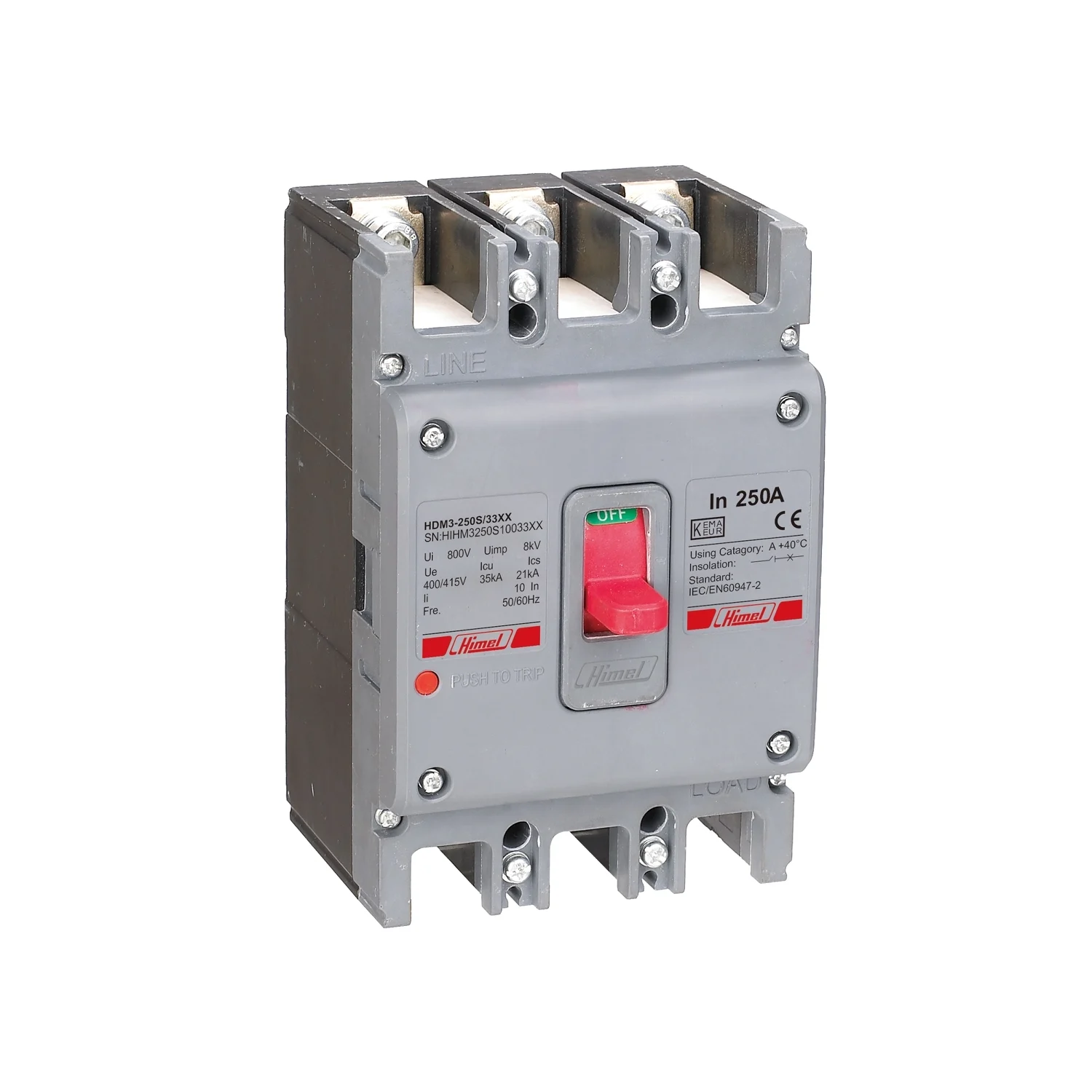
Icu says the MCCB can interrupt the fault; Ics says whether it is still fit for service afterwards. The Himel HDM3S adjustable thermal-magnetic range is published with Ics = 100% of Icu: 35/35 kA for the 160 A frame and 50/50 kA for the 250, 400 and 630 A frames. Where continuity matters, compare Ics with the fault level too.
Selectivity (discrimination) means only the breaker nearest the fault opens. Schneider Electric’s Cahier Technique 167 defines discrimination as total if only the most downstream breaker trips for all fault current values, and partial if that holds only up to a certain fault level. It sets out practical rules:
A board is fed by a Himel HDM3-250 thermal-magnetic MCCB, whose fixed magnetic trip is 10 × In = 2,500 A (HDM3 catalogue). Its outgoing 63 A C-curve MCBs trip instantaneously between 315 A and 630 A.
So the pair is selective for faults out on the final circuits and only partially selective close to the board. For total selectivity, use an upstream breaker with a short-time delay, such as the HDM3E with adjustable Isd and tsd. The catalogue notes that “short time delay protection is used to ensure the selectivity coordination with the downstream circuit breakers”.
Step up from an MCB to an MCCB when any one of these applies:
For a typical commercial building (bands are examples; your design calculation decides):
| Circuit | Design current (example) | Fault level at device (example) | Device | Deciding factor |
|---|---|---|---|---|
| Lighting final circuit | 6–20 A | Up to 6 kA | MCB, B or C curve, 6 kA or more | Low current and low fault level at a remote board |
| Socket outlet or small power final circuit | 16–32 A | Up to 10 kA | MCB, C curve, 10 kA (e.g. HDB9), with RCD protection where required | Within MCB limits |
| Large single load or sub-circuit in a DB | 63–125 A | Up to 10 kA | HDB3w-125 (IEC 60947-2, DIN rail) or a small-frame MCCB | Current above 63 A; standard required by the specification |
| Outgoing feeder from the main switchboard | 100–800 A | 25–50 kA | MCCB, HDM3 or HDM3S, Icu and Ics checked | Fault level and current both above MCB limits |
| Incoming breaker of a sub-main board | 160–630 A | 15–40 kA | MCCB with electronic trip and short-time delay (HDM3E) | Selectivity with the breakers downstream |
| Motor feeder to a starter or drive panel | Motor full-load current | Board fault level | MCCB magnetic-only (12 × In) plus overload relay, or HDP6 for small motors | Starting current and coordination with the starter |
| Fire pump or essential ventilation motor | Motor full-load current | Board fault level | MCCB with magnetic release or HRC fuses; no thermal trip | SCDF Fire Code 2023, clause 5.2.3 |
Thermal trip units are calibrated at a reference temperature. Singapore’s daytime maximum is typically 31–33 °C, according to the Meteorological Service Singapore, and an enclosed panel adds its own heat, so derating matters. The HDM3 catalogue gives these factors for 40 °C-calibrated products at 50 °C ambient: 0.89 for the HDM3-100, 0.85 for the HDM3-160/250, 0.87 for the HDM3-400/630 and 0.88 for the HDM3-800.
A 250 A HDM3-250 calibrated at 40 °C therefore carries about 250 × 0.85 ≈ 212 A in a 50 °C panel. Select the next rating or a 50 °C-calibrated reference (a “T” suffix in the HDM3S selection code). Most HDM3E frames need no derating up to 50 °C.
Our published case studies are drive and soft starter projects, so there is no breaker case study to cite here; these checks come from the data and standards above.
Trans-Digi Global is an authorised Himel distributor in Singapore. We stock the Himel HDB9 and HDB3w MCB ranges, the Himel HDM2 and HDM3 MCCB ranges, the HDP6 motor circuit breaker and the HDB3VR RCCB. Browse all moulded case circuit breakers and miniature circuit breakers.
Send your board schedule, the calculated fault level at each board and the upstream device through our contact page. We will confirm references and datasheets for your submission.
An MCB is a DIN-rail breaker for final circuits, tested to IEC 60898-1 up to 125 A and 25 kA. An MCCB is tested to IEC 60947-2, covers ratings up to 1,600 A in the Himel HDM range, has higher breaking capacities and can have adjustable or time-delayed trip units.
Use an MCCB when the current is above the MCB range, when the fault level at the board is above the MCB’s breaking capacity, when you need adjustable or time-delayed protection for selectivity, or for motor and fire pump circuits.
Neither is better in general. Each suits a different job. An MCB is the compact, economical choice for final circuits within its limits. An MCCB is needed where current, fault level or selectivity go beyond them.
Yes, up to 125 A. IEC 60898-1 covers MCBs up to 125 A, and the Himel HDB3w-125 provides ratings up to 125 A in a 27 mm-per-pole DIN-rail format, certified to IEC 60947-2.
At least the maximum prospective fault current where it is installed, unless a tested upstream device provides back-up protection. Near a 1,000 kVA transformer, a first estimate is about 29 kA. At remote boards it can be much lower, so calculate it board by board.
For most faults on the final circuit, yes, if the MCCB’s instantaneous threshold is at least 1.5 times the MCB’s. For high faults close to the board, selectivity may be only partial. Check the manufacturer’s coordination tables, or use an upstream MCCB with a short-time delay.
Electrical installations are designed to SS 638, the Code of Practice for Electrical Installations, by a licensed electrical worker. The breakers themselves are tested to IEC 60898-1 (MCBs) or IEC 60947-2 (MCCBs).
Send Jason the model or your motor rating — we'll confirm availability the same business day.
WhatsApp UsWhat to look for in a VSD for air handling units, cooling towers and chilled-water pumps: humidity and IP rating, harmonics, BMS protocols and cooling tower…
Read more
Soft starter or VFD for your pump? Compare starting current, running energy, harmonics and cost, with a decision matrix by pump duty, worked numbers and Singapore…
Read more
To replace a variable speed drive on site, first prove the drive has actually failed, then record everything the old unit was doing before you remove…
Read moreSend us your motor rating, voltage, application and quantity. We'll get back to you fast.